A Historic Moment for the Diamond World
For more than a century, De Beers has been synonymous with diamonds and, for many, synonymous with controversy.
From its origins in colonial South Africa to its dominance over the global rough diamond trade, De Beers has carried the weight of its history at every step. That history includes one of the most damaging chapters in luxury goods: blood diamonds. Conflict diamonds. Stones mined in war zones and used to finance brutal armed rebellions across Sierra Leone, Angola, and the Democratic Republic of Congo in the 1990s.
Now, in 2026, something remarkable is happening. Two African nations Botswana and Angola are raising their hands to buy De Beers. Not just a slice of it. Botswana wants controlling ownership. Angola has filed a fully financed formal bid for a significant stake.
If this sale goes through, De Beers the company once accused of profiting from African suffering could become majority-owned by Africa itself.
This article examines what that means: for blood diamond accountability, for the Kimberley Process, for consumers buying engagement rings today, and for the broader future of ethical diamond sourcing.
Part 1: What Is Actually Happening With De Beers in 2026?
Anglo American Is Selling Its 85% Stake
In May 2024, British mining giant Anglo American announced it would spin off or sell De Beers as part of a sweeping corporate restructuring. Anglo American holds 85% of De Beers. The Government of Botswana holds the remaining 15%.
The sale has been in structured process throughout 2025 and into 2026, with completion targeted for the first half of 2026.
The price? Following $2.3 billion in impairments in 2025 alone on top of $2.9 billion in 2024 the valuation has dropped substantially. Anglo American's 85% stake is now estimated at around $4.9 billion, down significantly from peak valuations.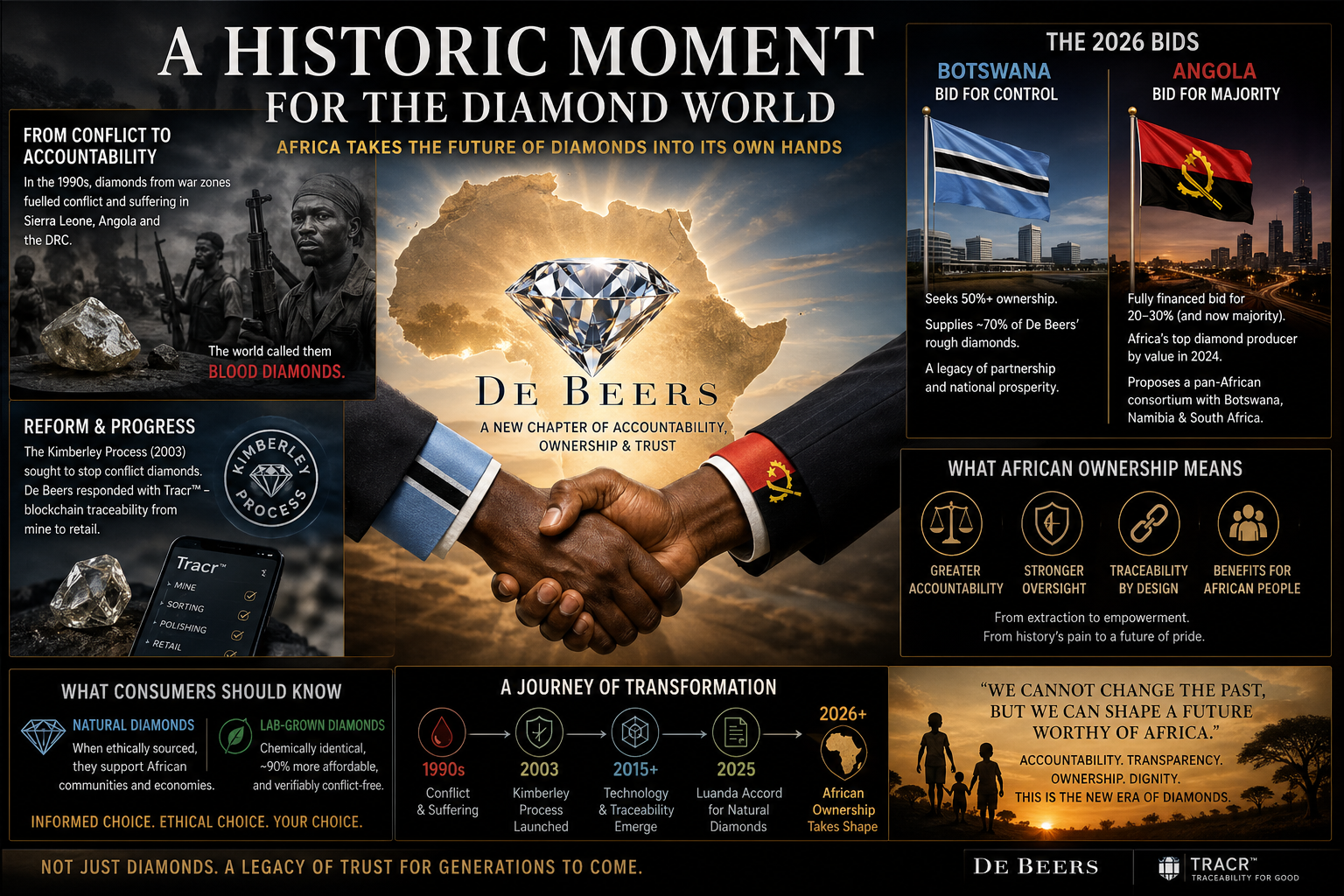
Botswana's Bold Bid for Control
Botswana's President Duma Boko has been unambiguous. His government wants a controlling stake 50% or more. In public statements to Bloomberg Television in September 2025, Boko said Botswana has "communicated our firm intention to increase our stake in De Beers to a controlling stake. We want to have effective control of the industry."
To finance this, Botswana has appointed global advisers including Lazard Ltd and Swiss-based Compagnie Bancaire Helvétique, and has lined up collaborators including Oman's sovereign wealth fund.
Botswana's claim is not without weight. The country is the world's largest diamond producer by value. The flagship Jwaneng mine the single richest diamond mine on Earth sits on Botswana soil. De Beers sources approximately 70% of its annual rough diamond output from Botswana.
For Botswana, this isn't just a financial investment. It is, as its mining minister has stated, a matter of national economic sovereignty.
Angola's Competing Bid
Angola's state-owned diamond company, Endiama, has also entered the race with a fully financed offer for a 20–30% minority stake. Angola's bid has evolved: in September 2025, it initially sought only a minority position. By November 2025, Endiama had escalated to a majority stake bid, directly competing with Botswana.
Angola's bid gains credibility from a remarkable milestone: in 2024, Angola overtook Botswana as Africa's largest diamond producer by value, generating $1.41 billion in rough diamond output. A new kimberlite discovery in August 2025 the first in Angola in nearly 30 years, confirmed through joint exploration with De Beers further strengthens Endiama's case for deeper ownership.
Interestingly, Angola has also invited Botswana, Namibia, and South Africa to join a pan-African consortium bid. "Our bid is designed to foster a partnership in which Botswana, Namibia, South Africa, and Angola all participate meaningfully ensuring that no single party dominates and that the company can grow as a truly international commercial entity," Angola's statement read.
As of early 2026, Botswana and Angola have held closed-door meetings exploring whether to compete or cooperate.
Part 2: What Are Blood Diamonds — And Why Does De Beers Still Matter?
The Origin of the Crisis
The term "blood diamond" also known as "conflict diamond" refers to rough diamonds mined in war zones and sold to finance armed conflict against governments.
In the 1990s, rebel groups in Sierra Leone (the RUF), Angola (UNITA), and the Democratic Republic of Congo used diamond revenues to purchase weapons, perpetuate civil wars, and commit widespread atrocities. Millions of civilians were displaced, mutilated, or killed.
De Beers, as the dominant force controlling up to 80–85% of the world's rough diamond supply at the time, was implicated not necessarily through direct purchase of conflict stones, but through a system that lacked transparency and enabled the laundering of conflict diamonds into legitimate supply chains.
The 2006 film "Blood Diamond" brought this history into mainstream global consciousness. It permanently altered consumer perception and forced the industry to confront long-buried accountability failures.
The Kimberley Process Reform That Came Too Late for Many
In response to international pressure, the Kimberley Process Certification Scheme (KPCS) was established in 2003. De Beers was an active participant in shaping it.
The KPCS requires participating governments to certify that rough diamond exports are conflict-free. De Beers stopped buying from open markets, partnering instead with stable governments in Botswana, Namibia, South Africa, and Canada.
For a time, this worked. Consumer confidence recovered. The "forever diamond" narrative was rebuilt.
But cracks appeared quickly.
Global Witness one of the founding NGO partners of the Kimberley Process withdrew from the scheme in 2011. Their reason: the KP was "fundamentally failing" to stop the flow of conflict diamonds. The definition of "conflict diamond" remained too narrow. Stones from Zimbabwe, mined under documented conditions of torture and murder, still passed KP certification because they weren't linked to rebel groups just to a government-controlled military operation.
The Kimberley Process, critics argue, fixed the optics of blood diamonds. It did not fix the reality.
Why 2026 Is a Defining Year
De Beers today is not the company of the 1990s. It has implemented the Tracr™ blockchain platform, enabling diamond-by-diamond traceability from mine to retail. It signed the Luanda Accord in 2025. It publishes annual Modern Slavery Statements. Its ORIGIN branded collection comes with verified provenance data.
But lab-grown diamonds have changed the game entirely. By 2025, lab-grown diamonds were approximately 90% cheaper than mined diamonds compared to just a 10% price gap in 2018. As cost parity disappears, consumers are choosing lab-grown not just for price, but for ethics.
For De Beers to survive as a natural diamond brand, accountability is no longer optional. It is the product.
This is the world into which Botswana and Angola are bidding to buy.
Part 3: What African Ownership Means for Blood Diamond Accountability
The Positive Case — Why This Could Be Transformative
1. The Nations That Were Exploited Become the Owners
There is a powerful symbolic and structural shift when the countries whose resources were extracted under colonial and conflict conditions take ownership of the extracting company. Botswana and Angola are not passive recipients of diamond revenue. They are becoming the architects of diamond policy.
Botswana's track record is instructive. Through its 50–50 joint venture Debswana, diamond revenues have funded national development hospitals, schools, infrastructure and transformed one of the world's poorest countries in the 1960s into a middle-income nation. This is the model of diamond revenue done right.
For blood diamond accountability, Botswana's ownership of De Beers would mean the country most dependent on diamonds having the strongest possible incentive to ensure those diamonds are ethically sourced. Accountability is not charity for Botswana it is economic necessity.
2. The Luanda Accord Gains Enforcement Teeth
The Luanda Accord, signed in 2025, formalises a government-industry commitment to market and protect natural diamonds. With Angola and Botswana as owners rather than just signatories, the Accord gains something it currently lacks: enforcement authority. Government co-owners have the legal standing, institutional leverage, and financial motivation to ensure compliance across the supply chain.
3. Pan-African Consortium Creates Multi-Nation Accountability Layer
Angola's proposal to bring Botswana, Namibia, and South Africa together as co-owners is particularly significant. A consortium of four African diamond-producing governments owning De Beers creates a multi-jurisdictional accountability framework. No single nation can quietly overlook supply chain violations when three others are co-owners with reputational stakes.
4. Tracr™ Blockchain — Already Deployed, Now State-Backed
De Beers' Tracr™ platform already records every stage of a diamond's journey digitally — mining, sorting, polishing, setting. Under African government ownership, this technology could become a regulatory requirement rather than a voluntary brand promise. State-backed mandatory traceability is meaningfully stronger than corporate-voluntary traceability.
5. Resetting the Brand Narrative for the Global South
For consumers in India now the world's second-largest diamond jewellery market and across Southeast Asia and Africa, a De Beers owned by African governments carries a fundamentally different story than a De Beers owned by a British mining conglomerate. The blood diamond narrative was, at its core, a story of African suffering for Western profit. African ownership inverts that story.
The Nuanced Considerations — Where Complexity Remains
1. Angola's Own Complex History
Angola was ground zero for blood diamonds. UNITA's diamond-funded war caused roughly 500,000 deaths. Endiama, the state company now bidding for De Beers, operated during that era — and the Angolan government's own relationship with diamond revenues in the 1990s was not without controversy.
This does not disqualify Angola's 2026 bid. Countries evolve. Angola's diamond sector has been substantially reformed. But accountability-focused consumers and NGOs will legitimately ask whether a company with Angola as a major shareholder can credibly market itself as conflict-free. The answer will depend entirely on the governance structures established in the ownership agreement.
2. Government Ownership and Independent Oversight
The Kimberley Process's greatest weakness is that it relies on governments to self-certify. When a government owns the mining company, the self-certification problem deepens. Independent civil society oversight — the role once played by Global Witness before it withdrew — becomes even more critical when the regulator and the regulated share the same ownership.
For this reason, any Botswana or Angola ownership deal should, to maximise accountability, include independent board seats for civil society organisations, third-party audit requirements, and enforceable supply chain transparency standards beyond what the KP currently demands.
3. The Lab-Grown Competitive Pressure
De Beers faces existential competitive pressure from lab-grown diamonds. Its decision in May 2025 to discontinue the Lightbox lab-grown brand and reposition entirely as a luxury natural diamond company is a high-stakes bet. Under African government ownership, the pressure to generate revenues for national economies may prioritise production volume over ethics reform.
This is not inevitable. But it is a risk that accountability advocates must monitor.
Part 4: The Bigger Picture — What This Means for the Diamond Industry
A New Chapter for African Resource Sovereignty
The De Beers acquisition bids are part of a broader, decades-long movement across Africa to reclaim value from natural resources that have historically been extracted and exported with minimal local benefit.
From the DRC's coltan to Nigeria's oil to South Africa's platinum, African governments are increasingly asserting ownership rights over the full value chain — not just royalties and taxes, but equity, branding, marketing, and global pricing power.
De Beers is potentially the highest-profile example of this shift yet. If Botswana secures a majority stake, it will own not just the mines but the most recognised diamond brand in human history. That is an extraordinary development — and one with implications far beyond the diamond industry.
What Consumers Should Know in 2026
If you are buying a diamond engagement ring, a diamond necklace, or any natural diamond jewellery in 2026, here is what the De Beers ownership transition means for you:
The direction of travel is positive. African government ownership, combined with Tracr™ blockchain traceability and the Luanda Accord framework, represents the most significant structural shift toward ethical accountability since the Kimberley Process launched in 2003.
The work is not finished. The KP still needs reform. Angola's governance history requires scrutiny. Independent oversight mechanisms need to be built into any ownership deal.
And if ethics is your primary concern, lab-grown diamonds remain the most verifiably conflict-free option available — regardless of who owns De Beers.
Part 5: Frequently Asked Questions (FAQ)
Q: Are De Beers diamonds blood diamonds in 2026? De Beers diamonds are not classified as blood diamonds under the Kimberley Process Certification Scheme. The company sources exclusively from its own mines in Botswana, Namibia, South Africa, and Canada, all of which are KP-certified. However, critics note the KP's definition of conflict diamonds remains narrow, and independent oversight is limited. De Beers' Tracr™ blockchain platform provides additional traceability beyond KP requirements.
Q: Why are Botswana and Angola buying De Beers? Both countries are major diamond producers seeking greater control over their primary natural resource. Botswana supplies approximately 70% of De Beers' annual output and wants to move from raw material producer to strategic controller of global diamond branding, pricing, and marketing. Angola has emerged as Africa's top diamond producer by value and sees ownership as part of a broader resource sovereignty strategy.
Q: What is the Luanda Accord and why does it matter? The Luanda Accord, signed in 2025, is a formal agreement between diamond-producing governments and the industry to jointly market and protect the value of natural diamonds. It represents a government-backed commitment to the natural diamond sector at a time when lab-grown diamonds are threatening market share. African ownership of De Beers would give this accord significantly stronger enforcement potential.
Q: What is Tracr™ and does it solve the blood diamond problem? Tracr™ is De Beers' blockchain-based diamond traceability platform. It records each diamond's journey from mine to retail digitally. It is a meaningful improvement over paper certification. However, it is currently a voluntary corporate system rather than a mandatory regulatory requirement. Its effectiveness depends on all supply chain partners adopting it — which has not yet been universally achieved.
Q: Should I buy a natural diamond or lab-grown in 2026? Lab-grown diamonds are chemically identical to mined diamonds and are now approximately 90% cheaper. They are verifiably free of any conflict association. Natural diamonds, when properly certified and traced, support African mining communities and economies. The right choice depends on your personal priorities: price and verified ethics favour lab-grown; supporting African economies and valuing rarity may favour natural. Either choice, made with information, is a responsible one.
Q: When will the De Beers sale be completed? Anglo American has targeted completion of the De Beers sale in the first half of 2026. As of April 2026, the structured sale process is ongoing, with Botswana and Angola the primary bidders alongside potential international investors.
Conclusion: A Turning Point That Could Rewrite History
The phrase "blood diamond" is not just a historical label. For millions of people in Sierra Leone, Angola, and the DRC, it represents real, lived trauma — a past in which the world's hunger for luxury came at the cost of their safety, their families, and their lives. That history cannot be undone.
But the potential future now taking shape where the nations that bore that cost take ownership of the industry, deploy traceable technology, establish government-level accountability frameworks, and bring transparency to a supply chain that operated in darkness for a century represents something genuinely meaningful.
Botswana and Angola wanting De Beers is not a guarantee of a clean industry. Governance must be built carefully. Independent oversight must be enshrined. The Kimberley Process must be reformed. Lab-grown diamonds will continue to offer consumers a simpler ethical choice.
But the direction of travel is clear. And it points, for the first time in the long and complicated history of diamonds, toward accountability rooted in African agency.
That is not a small thing. That is a turning point.